
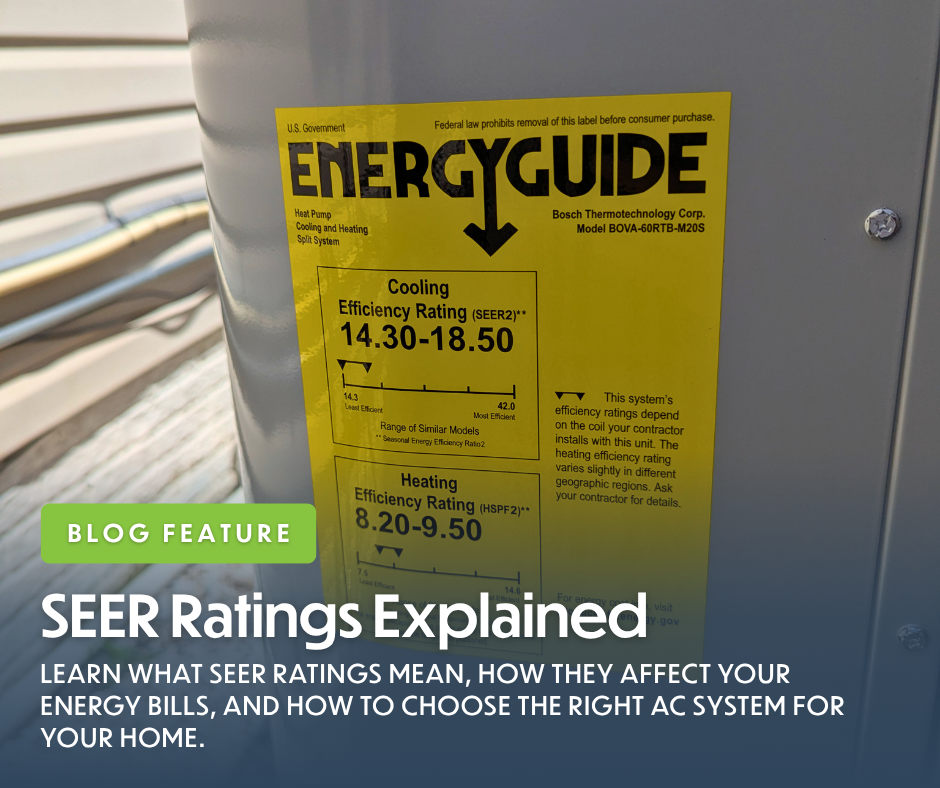
If you’ve started researching a new air conditioner, you’ve probably come across the term SEER. It’s listed on equipment specifications, mentioned in replacement quotes, and often used to compare systems.
But what does it actually mean?
In this guide, we’ll break down SEER ratings explained in simple terms, so you can understand how efficiency works, how it affects your energy bills, and how to choose the right system for your home in Stafford, Fredericksburg, Spotsylvania, King George, or anywhere in Northern Virginia.
What Is a SEER Rating?
SEER stands for Seasonal Energy Efficiency Ratio.
It measures how efficiently an air conditioning system cools your home over an entire cooling season compared to the amount of electricity it uses.
In simple terms:
The higher the SEER rating, the more energy efficient the system.
Think of it like miles per gallon for your car. A higher MPG means better fuel efficiency. Similarly, a higher SEER rating means your AC uses less electricity to produce the same amount of cooling.
How SEER Is Calculated
SEER is calculated by dividing the total cooling output (in BTUs) during a typical cooling season by the total electrical energy input (in watt-hours) during that same period.
You don’t need to memorize the formula, but understanding the concept helps:
A system with a SEER rating of 16 is more efficient than one with a SEER rating of 13 because it produces more cooling per unit of electricity consumed.
The difference may seem small numerically, but it can have a noticeable impact on long-term operating costs.
What Is SEER2? 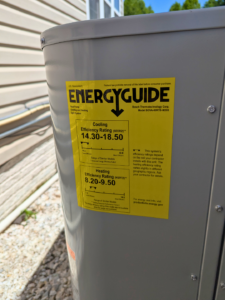
In recent years, the Department of Energy mandated that efficiency testing standards should be updated, and you may now see SEER2 ratings instead of traditional SEER.
SEER2 reflects updated testing conditions that more accurately represent real-world performance. The numbers may look slightly lower compared to older SEER ratings, but they’re measured under stricter standards.
For homeowners replacing older equipment, it’s important to compare systems using the same rating standard.
What Is the Minimum SEER Rating?
Efficiency requirements vary by region.
In Virginia and the Southeast region, current regulations require new air conditioners to meet higher minimum efficiency standards than in the past.
Most new systems today start around 14–15 SEER2 (or the equivalent SEER rating under previous standards). Many high-efficiency systems range from 16 to 20+ SEER.
If your current system is 10–15 years old, it may have a SEER rating as low as 8–13. That means modern equipment can be significantly more efficient.
Why SEER Ratings Matter in Virginia 
SEER ratings are especially important in climates like Virginia, where cooling seasons are long and humidity levels are high.
Your air conditioner doesn’t just run occasionally during the summer. It works consistently for months. That extended runtime means efficiency differences can noticeably impact:
- Monthly utility bills
- System wear and tear
- Indoor comfort levels
A higher efficiency system reduces overall energy consumption while maintaining consistent cooling performance.
How Much Can a Higher SEER2 Rating Save?
The exact savings depend on your home size, insulation, ductwork condition, and how often you run your system. However, upgrading from an older unit to a high-efficiency system can reduce cooling energy usage by roughly 30–40%.
Over several years, those savings can offset part of the upfront investment in a higher efficiency unit.
It’s important to remember that savings aren’t just about the SEER2 rating alone. Installation quality, proper sizing, and regular maintenance all play a role in real-world efficiency.
Is a Higher SEER2 Always Better?
This is one of the most common questions homeowners ask.
While higher SEER2 systems are more efficient, that doesn’t automatically mean the highest rating is the best choice for every home.
Higher SEER2 units often come with:
- Increased upfront cost
- More advanced components
- Variable-speed technology
In some cases, the additional efficiency may not produce enough energy savings to justify the higher price, especially if you plan to move in a few years.
Choosing the right SEER2 rating is about balancing:
- Budget
- Long-term plans
- Energy goals
- Home layout
- Climate conditions
For many Virginia homeowners, systems in the 16–20 SEER2 range provide an excellent balance of performance and value.
SEER and System Sizing 
Efficiency alone does not determine comfort.
An oversized unit can short-cycle, meaning it turns on and off frequently. This reduces humidity control and can increase wear on components.
An undersized unit may run constantly and struggle to cool your home.
Proper load calculations performed by a licensed HVAC professional are just as important as selecting the right SEER2 rating.
Variable-Speed vs Single-Stage Systems
Many higher SEER2 systems use variable-speed compressors or multi-stage technology.
Single-stage systems operate at full capacity whenever they run. Variable-speed systems adjust output based on demand.
The result is:
- More consistent indoor temperatures
- Better humidity control
- Quieter operation
- Improved efficiency
In Virginia’s humid summers, variable-speed systems can make a noticeable difference in comfort.
When Should You Consider Upgrading Based on SEER? 
You may want to consider replacement if:
- Your system is 12–15+ years old
- Your energy bills are rising
- Your current unit has a low SEER rating
- You’re facing major repair costs
Older low-efficiency systems cost more to operate over time. Even if they still function, they may not be cost-effective long term.
SEER2 Ratings and Environmental Impact
Higher efficiency systems consume less electricity. Lower energy usage reduces strain on the power grid and lowers overall carbon emissions.
For homeowners interested in reducing their environmental footprint, upgrading to a high-efficiency system can be a meaningful step.
Additionally, modern systems use updated refrigerants that are more environmentally responsible than older options.
Common Misconceptions About SEER2
Some homeowners assume that installing a higher SEER2 system will automatically cut energy bills dramatically. While efficiency plays a major role, factors like insulation, duct leakage, and maintenance also impact performance.
Others believe that the highest SEER2 rating available is always the best investment. In reality, the best choice depends on your specific home and comfort needs.
SEER2 ratings are one piece of the puzzle — not the entire picture.
How to Choose the Right SEER2 Rating for Your Home 
Selecting the right system involves more than comparing numbers on a brochure.
A professional evaluation should consider:
- Square footage
- Ceiling height
- Insulation levels
- Window placement
- Ductwork condition
- Household cooling habits
In Virginia homes, humidity control is often just as important as raw cooling capacity. That’s why system design matters as much as efficiency rating.
The Bottom Line: SEER2 Ratings Explained Simply
SEER2 measures energy efficiency. Higher numbers mean better efficiency.
However, the right SEER2 rating depends on your home, budget, and long-term plans.
If your current system is older and inefficient, upgrading to a modern high-efficiency unit can reduce energy usage, improve comfort, and provide better humidity control during Virginia’s long summers.
But the best results come from proper sizing, professional installation, and regular maintenance.
Thinking About Upgrading Your AC?
If you’re considering replacing your air conditioner and want guidance on SEER2 ratings and system efficiency, Kasper Mechanical Heating and Air Conditioning can help.
Our team serves homeowners throughout Stafford, Fredericksburg, Spotsylvania, and King George with honest system evaluations and professional installation.
We’ll help you:
- Understand your current system’s efficiency
- Compare replacement options
- Choose the right SEER2 rating for your home
- Maximize long-term comfort and savings
Contact us today to schedule a consultation and find the right high-efficiency solution for your home.